How Does a Capacitor Work?
I. Introduction
Capacitors are fundamental components in the world of electronics, playing a crucial role in various electrical circuits. Defined as passive electronic components that store and release electrical energy, capacitors are essential for a wide range of applications, from filtering signals to energy storage in power systems. This article will explore the principles behind how capacitors work, their components, types, applications, advantages, limitations, and future innovations in capacitor technology.
II. Basic Principles of Electricity
To understand how capacitors function, it is essential to grasp some basic principles of electricity.
A. Overview of Electric Charge
Electric charge is a fundamental property of matter, existing in two types: positive and negative. Protons carry a positive charge, while electrons carry a negative charge. The interaction between these charges is what creates electric fields and currents.
B. Voltage and Current
Voltage, or electric potential difference, is the force that pushes electric charges through a circuit. It is measured in volts (V). Current, measured in amperes (A), is the flow of electric charge. The relationship between voltage, current, and resistance is described by Ohm's Law, which states that \( V = I \times R \), where \( R \) is resistance measured in ohms (Ω). This relationship is crucial for understanding how capacitors operate within circuits.
III. What is a Capacitor?
A. Definition and Function
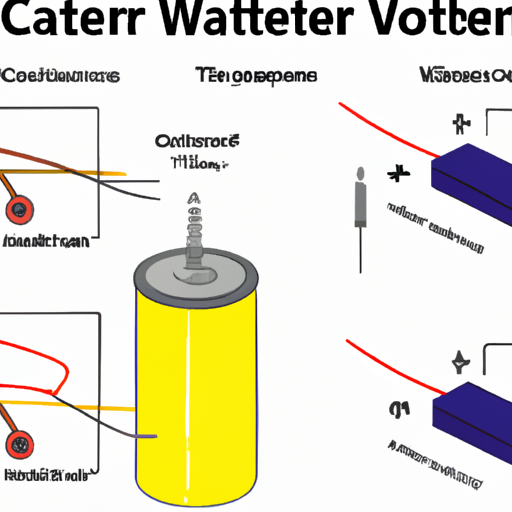
A capacitor is a two-terminal passive electronic component that stores electrical energy in an electric field. When connected to a voltage source, it can accumulate charge on its plates, allowing it to store energy for later use.
B. Basic Components of a Capacitor
1. **Conductive Plates**: Capacitors consist of two conductive plates that are separated by an insulating material known as a dielectric. The plates are typically made of metals such as aluminum or tantalum.
2. **Dielectric Material**: The dielectric is a non-conductive substance that increases the capacitor's ability to store charge. Common dielectric materials include air, ceramic, plastic, and electrolytic substances.
C. Types of Capacitors
There are several types of capacitors, each with unique characteristics and applications:
1. **Ceramic Capacitors**: These are widely used for their stability and reliability, often found in high-frequency applications.
2. **Electrolytic Capacitors**: Known for their high capacitance values, these capacitors are polarized and typically used in power supply circuits.
3. **Tantalum Capacitors**: Similar to electrolytic capacitors but with better performance in terms of size and reliability, they are often used in compact electronic devices.
4. **Film Capacitors**: These capacitors use a thin plastic film as the dielectric and are known for their stability and low loss.
5. **Supercapacitors**: Also known as ultracapacitors, these devices can store large amounts of energy and are used in applications requiring rapid charge and discharge cycles.
IV. How Capacitors Store Energy
A. The Charging Process
When a voltage is applied across the terminals of a capacitor, an electric field is created between the conductive plates. This causes charge carriers (electrons) to move, accumulating on one plate while depleting from the other. The result is a stored electric charge, which can be released when needed.
B. The Role of the Dielectric
The dielectric material plays a crucial role in energy storage. It acts as an insulator, preventing the flow of current between the plates while allowing the electric field to develop. The dielectric constant, a measure of a material's ability to store electrical energy, significantly affects the capacitance of the capacitor.
C. The Concept of Capacitance
Capacitance, measured in farads (F), is defined as the amount of charge a capacitor can store per unit voltage. Several factors influence capacitance:
1. **Area of Plates**: Larger plate areas allow for more charge storage.
2. **Distance Between Plates**: Closer plates increase capacitance due to a stronger electric field.
3. **Dielectric Material**: Different materials have varying dielectric constants, affecting the capacitor's overall capacitance.
V. Discharging a Capacitor
A. The Discharging Process
When a capacitor is disconnected from the voltage source and connected to a load, it begins to discharge, releasing the stored energy. This process generates a current flow, which can power devices or circuits.
B. Time Constant and Its Significance
The time constant (τ) is a critical parameter in capacitor discharge, defined as the product of resistance (R) and capacitance (C) in an RC circuit. It indicates how quickly a capacitor charges or discharges. The voltage across the capacitor decreases exponentially over time, following the equation \( V(t) = V_0 e^{-t/τ} \), where \( V_0 \) is the initial voltage.
VI. Applications of Capacitors
Capacitors are used in various applications across different fields:
A. In Electronic Circuits
1. **Filtering and Smoothing**: Capacitors are used in power supply circuits to smooth out voltage fluctuations, providing a stable output.
2. **Timing Applications**: In oscillators and timers, capacitors help control the timing intervals.
3. **Coupling and Decoupling**: Capacitors can couple AC signals between stages of an amplifier while blocking DC, or decouple power supply variations from sensitive components.
B. In Power Systems
1. **Power Factor Correction**: Capacitors improve the power factor in electrical systems, reducing energy losses and improving efficiency.
2. **Energy Storage in Renewable Energy Systems**: Capacitors store energy generated from renewable sources, such as solar and wind, for later use.
C. In Everyday Devices
Capacitors are found in smartphones, computers, appliances, and many other electronic devices, playing a vital role in their functionality.
VII. Advantages and Limitations of Capacitors
A. Advantages
1. **Fast Response Time**: Capacitors can charge and discharge quickly, making them ideal for applications requiring rapid energy delivery.
2. **Ability to Store and Release Energy Quickly**: This characteristic is crucial in applications like power conditioning and energy recovery.
B. Limitations
1. **Energy Density Compared to Batteries**: Capacitors generally store less energy than batteries, making them less suitable for long-term energy storage.
2. **Voltage Ratings and Breakdown**: Capacitors have specific voltage ratings, and exceeding these can lead to breakdown and failure.
VIII. Future of Capacitors
A. Innovations in Capacitor Technology
1. **Development of New Materials**: Researchers are exploring advanced materials to enhance capacitance and energy density.
2. **Advances in Supercapacitors**: Innovations in supercapacitor technology aim to improve energy storage capabilities, making them more competitive with batteries.
B. Potential Impact on Energy Storage Solutions
As the demand for efficient energy storage solutions grows, advancements in capacitor technology could play a significant role in the future of renewable energy systems and electric vehicles.
IX. Conclusion
Capacitors are indispensable components in modern electronics, enabling a wide range of applications from energy storage to signal processing. Understanding how capacitors work, their types, and their applications provides valuable insights into their importance in technology. As innovations continue to emerge, capacitors will undoubtedly play a pivotal role in shaping the future of energy storage and electronic devices.
X. References
For further study on capacitors and their applications, consider exploring the following resources:
1. "The Art of Electronics" by Paul Horowitz and Winfield Hill
2. "Capacitors: Technology and Applications" by John Smith
3. Academic journals and articles on capacitor technology and advancements in energy storage solutions.


