What are the Product Characteristics of Standard Capacitors?
I. Introduction
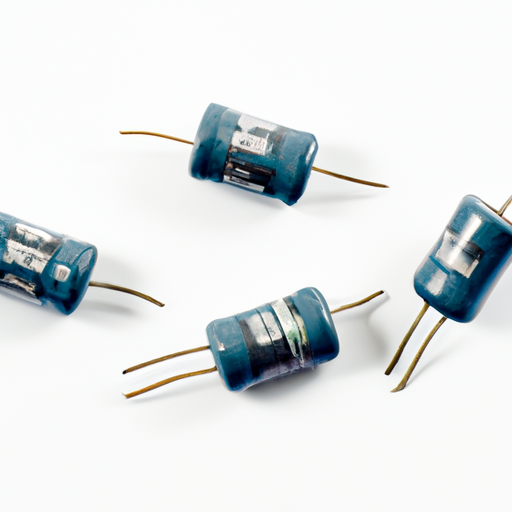
Capacitors are fundamental components in electronic circuits, serving as energy storage devices that can release energy when needed. They play a crucial role in various applications, from power supply filtering to signal coupling and timing circuits. Standard capacitors, which are widely used in the industry, come in various types and specifications, each tailored for specific applications. Understanding the product characteristics of standard capacitors is essential for engineers and designers to select the right component for their projects.
II. Basic Principles of Capacitors
A. How Capacitors Work
Capacitors operate on the principle of charge storage. When a voltage is applied across the terminals of a capacitor, an electric field is created, allowing the capacitor to store electrical energy in the form of an electric charge. The amount of charge a capacitor can store is defined by its capacitance, measured in farads (F), which is a unit that quantifies the capacitor's ability to hold charge per unit voltage.
B. Types of Capacitors
There are several types of capacitors, each with unique characteristics:
1. **Electrolytic Capacitors**: Known for their high capacitance values, these capacitors are polarized and typically used in power supply applications.
2. **Ceramic Capacitors**: These are non-polarized capacitors with a wide range of capacitance values, often used in high-frequency applications.
3. **Film Capacitors**: Made from thin plastic films, these capacitors are known for their stability and low loss, making them suitable for audio and timing applications.
4. **Tantalum Capacitors**: These capacitors offer high capacitance in a small package and are often used in compact electronic devices.
5. **Supercapacitors**: Also known as ultracapacitors, these devices can store large amounts of energy and are used in applications requiring rapid charge and discharge cycles.
III. Key Product Characteristics of Standard Capacitors
A. Capacitance Value
The capacitance value is a critical characteristic of capacitors, indicating how much charge a capacitor can store at a given voltage. It is measured in farads, with common values ranging from picofarads (pF) to microfarads (µF) and even millifarads (mF) for larger capacitors. The choice of capacitance value depends on the specific application; for instance, larger capacitance values are typically used in power supply filtering, while smaller values are used in timing circuits.
B. Voltage Rating
The voltage rating of a capacitor indicates the maximum voltage that can be applied across its terminals without risking breakdown or failure. It is crucial to select a capacitor with a voltage rating higher than the maximum voltage expected in the circuit. Derating, or selecting a capacitor with a voltage rating significantly higher than the operating voltage, is a common practice to enhance reliability and safety.
C. Tolerance
Tolerance refers to the allowable variation in capacitance from the specified value. It is expressed as a percentage and is important for applications where precise capacitance is required. Common tolerance levels include ±5%, ±10%, and ±20%. A tighter tolerance is often necessary in timing circuits, while a looser tolerance may be acceptable in power supply applications.
D. Temperature Coefficient
The temperature coefficient describes how a capacitor's capacitance changes with temperature. Different types of capacitors have different temperature coefficients, such as X7R and C0G, which indicate their stability over temperature variations. Understanding the temperature coefficient is essential for applications exposed to varying environmental conditions.
E. Equivalent Series Resistance (ESR)
ESR is a measure of the resistive losses within a capacitor when it is subjected to an AC signal. It impacts the capacitor's performance, especially in high-frequency applications. A lower ESR is desirable for applications such as power supply decoupling, where efficiency and performance are critical.
F. Equivalent Series Inductance (ESL)
ESL is the inductance that appears in series with the capacitor due to its physical construction. It becomes significant at high frequencies, affecting the capacitor's performance in RF applications. Understanding ESL is crucial for designing circuits that operate at high frequencies, as it can influence the overall impedance of the capacitor.
G. Leakage Current
Leakage current is the small amount of current that flows through a capacitor even when it is not connected to a circuit. It is an important characteristic, as excessive leakage can lead to power loss and affect circuit performance. Measuring leakage current is essential for applications requiring low power consumption.
H. Size and Form Factor
The physical dimensions and form factor of a capacitor can significantly impact circuit design. Capacitors come in various package types, including through-hole and surface mount. The choice of size and form factor depends on the available space on the circuit board and the specific application requirements.
IV. Performance Characteristics
A. Frequency Response
The frequency response of a capacitor describes how its impedance changes with frequency. Capacitors are often used in filtering applications, where their ability to block or pass certain frequencies is critical. Understanding the frequency response is essential for designing circuits that require specific filtering characteristics.
B. Aging and Reliability
Capacitors can degrade over time due to various factors, including temperature, voltage stress, and environmental conditions. Aging can lead to changes in capacitance, increased ESR, and reduced reliability. Selecting capacitors with a proven track record of reliability is crucial for critical applications, such as automotive and aerospace systems.
C. Self-Resonant Frequency
The self-resonant frequency is the frequency at which a capacitor's reactance becomes zero, and it starts to behave like an inductor. This characteristic is significant in RF circuits, where capacitors are used for tuning and filtering. Understanding the self-resonant frequency helps engineers design circuits that operate efficiently at desired frequencies.
V. Applications of Standard Capacitors
Standard capacitors find applications in various fields, including:
A. Power Supply Filtering
Capacitors are widely used in power supply circuits to smooth out voltage fluctuations and provide stable DC output. They help filter out noise and ripple, ensuring that electronic devices operate reliably.
B. Signal Coupling and Decoupling
In audio and communication circuits, capacitors are used for coupling and decoupling signals. They allow AC signals to pass while blocking DC components, ensuring that only the desired signals are transmitted.
C. Timing Circuits
Capacitors play a crucial role in timing circuits, where they work in conjunction with resistors to create time delays. This is essential in applications such as oscillators and timers.
D. Energy Storage
Capacitors are used for energy storage in various applications, including backup power systems and regenerative braking in electric vehicles. Their ability to charge and discharge rapidly makes them ideal for these purposes.
E. Audio Applications
In audio circuits, capacitors are used for filtering, coupling, and decoupling signals. They help improve sound quality by eliminating unwanted noise and ensuring that audio signals are transmitted accurately.
VI. Conclusion
Understanding the product characteristics of standard capacitors is essential for selecting the right component for specific applications. Key characteristics such as capacitance value, voltage rating, tolerance, and temperature coefficient play a significant role in determining a capacitor's performance in a circuit. As technology advances, the demand for more efficient and reliable capacitors continues to grow, leading to innovations in capacitor design and materials. By staying informed about these trends, engineers can make better decisions in their designs, ensuring optimal performance and reliability in their electronic systems.
VII. References
1. "Capacitor Basics: Understanding Capacitors" - Electronics Tutorials
2. "Capacitor Selection Guide" - Digi-Key Electronics
3. "Understanding Capacitor Specifications" - Mouser Electronics
4. "The Role of Capacitors in Electronic Circuits" - IEEE Spectrum
5. "Capacitor Aging and Reliability" - Journal of Electronic Materials
This blog post provides a comprehensive overview of the product characteristics of standard capacitors, suitable for engineers and enthusiasts looking to deepen their understanding of this essential electronic component.


