What are the Mainstream Models of Resistor Wiring Diagrams?
I. Introduction
In the world of electronics, understanding how components interact within a circuit is crucial for both design and troubleshooting. One of the fundamental components in any electronic circuit is the resistor. Resistor wiring diagrams serve as visual representations of how resistors are connected within a circuit, providing essential information for engineers, hobbyists, and students alike. This article will explore the mainstream models of resistor wiring diagrams, their configurations, practical applications, and the tools available for creating these diagrams.
II. Basic Concepts of Resistors
A. What is a Resistor?
A resistor is a passive electronic component that limits the flow of electric current in a circuit. Its primary function is to provide resistance, which is measured in ohms (Ω). Resistors come in various types, including fixed resistors, which have a constant resistance value, and variable resistors, such as potentiometers, which allow for adjustable resistance.
B. Ohm’s Law
Ohm’s Law is a fundamental principle in electronics that describes the relationship between voltage (V), current (I), and resistance (R). It states that V = I × R. This relationship is crucial in circuit design, as it helps engineers calculate how much current will flow through a resistor when a specific voltage is applied. Understanding Ohm’s Law is essential for interpreting resistor wiring diagrams and designing effective circuits.
III. Types of Resistor Wiring Configurations
A. Series Configuration
In a series configuration, resistors are connected end-to-end, forming a single path for current to flow. The total resistance in a series circuit is the sum of the individual resistances. For example, if three resistors of 2Ω, 3Ω, and 5Ω are connected in series, the total resistance is 2 + 3 + 5 = 10Ω.
1. Voltage and Current Relationships
In a series circuit, the current remains constant throughout all components, while the voltage across each resistor can vary. The total voltage across the circuit is equal to the sum of the voltages across each resistor.
2. Wiring Diagram Example
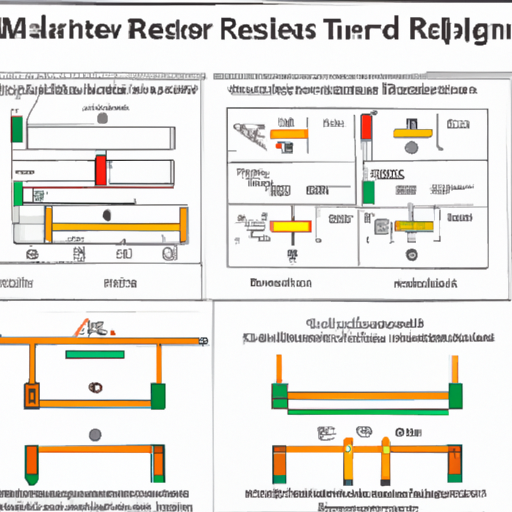
A simple series wiring diagram would show three resistors connected in a line, with arrows indicating the direction of current flow and labels for voltage drops across each resistor.
B. Parallel Configuration
In a parallel configuration, resistors are connected across the same two points, creating multiple paths for current to flow. The total resistance in a parallel circuit is calculated using the formula:
\[
\frac{1}{R_{total}} = \frac{1}{R_1} + \frac{1}{R_2} + \frac{1}{R_3}
\]
1. Voltage and Current Relationships
In a parallel circuit, the voltage across each resistor is the same, while the current can vary. The total current flowing into the circuit is the sum of the currents through each parallel branch.
2. Wiring Diagram Example
A parallel wiring diagram would depict resistors connected side by side, with lines indicating the paths for current flow and annotations for voltage levels.
C. Series-Parallel Configuration
A series-parallel configuration combines both series and parallel connections, allowing for more complex circuit designs. This configuration is often used in applications where specific voltage and current requirements must be met.
1. Applications in Circuit Design
Series-parallel configurations are commonly found in power distribution systems and audio equipment, where different components require varying levels of voltage and current.
2. Wiring Diagram Example
A wiring diagram for a series-parallel circuit would illustrate a combination of series and parallel connections, clearly labeling each resistor and the overall circuit layout.
IV. Common Resistor Wiring Diagrams
A. Simple Series Circuit Diagram
A simple series circuit diagram typically includes a power source, a series of resistors, and connecting wires. The layout shows how current flows through each resistor, allowing for easy analysis of current distribution.
1. Analysis of Current Flow
In a simple series circuit, the same current flows through each resistor, making it straightforward to calculate the total current using Ohm’s Law.
B. Simple Parallel Circuit Diagram
A simple parallel circuit diagram features a power source with multiple resistors connected in parallel. This layout highlights the equal voltage across each resistor and the different current paths.
1. Analysis of Voltage Distribution
In a parallel circuit, the voltage remains constant across all resistors, making it easy to determine the current through each branch using Ohm’s Law.
C. Complex Series-Parallel Circuit Diagram
A complex series-parallel circuit diagram combines multiple series and parallel connections, often used in more advanced electronic devices.
1. Analysis of Combined Effects
Analyzing a complex circuit requires understanding how series and parallel components interact, which can be achieved through systematic calculations of total resistance, voltage, and current.
D. Voltage Divider Circuit
A voltage divider circuit is designed to produce a specific output voltage that is a fraction of the input voltage. It typically consists of two resistors in series.
1. Wiring Diagram and Analysis
The wiring diagram for a voltage divider shows the two resistors connected in series with the output voltage taken from the junction between them. The output voltage can be calculated using the formula:
\[
V_{out} = V_{in} \times \frac{R_2}{R_1 + R_2}
\]
E. Current Divider Circuit
A current divider circuit is used to split the input current among multiple parallel branches. It is particularly useful in applications where different components require different current levels.
1. Wiring Diagram and Analysis
The wiring diagram for a current divider shows multiple resistors connected in parallel, with the output current through each branch calculated based on the total input current and the resistance values.
V. Practical Applications of Resistor Wiring Diagrams
A. Use in Electronic Devices
Resistor wiring diagrams are essential in the design and analysis of electronic devices. They are used in consumer electronics, such as televisions and smartphones, as well as in industrial applications like motor control systems.
B. Importance in Circuit Design and Troubleshooting
Understanding resistor wiring diagrams is crucial for identifying faults in circuits and optimizing performance. Engineers and technicians rely on these diagrams to diagnose issues and make necessary adjustments to improve circuit functionality.
VI. Tools and Software for Creating Resistor Wiring Diagrams
A. Traditional Methods (Paper and Pencil)
While traditional methods of drawing wiring diagrams with paper and pencil are still used, they can be time-consuming and prone to errors.
B. Modern Software Tools
1. Circuit Simulation Software
Circuit simulation software allows users to create and test circuit designs virtually, providing insights into how circuits will behave under different conditions.
2. CAD Software for Electrical Design
Computer-Aided Design (CAD) software offers advanced features for creating detailed wiring diagrams, making it easier to visualize complex circuits.
C. Benefits of Using Software Tools
Using software tools for creating resistor wiring diagrams enhances accuracy, saves time, and allows for easy modifications and simulations.
VII. Conclusion
In summary, understanding resistor wiring diagrams is essential for anyone involved in electronics, from students to seasoned engineers. By mastering the various configurations and applications of resistors, individuals can design effective circuits and troubleshoot issues with confidence. As technology continues to evolve, the importance of these diagrams will only grow, making it crucial for learners to explore further and deepen their knowledge in this area.
VIII. References
A. Suggested Reading Materials
1. "The Art of Electronics" by Paul Horowitz and Winfield Hill
2. "Electronics for Dummies" by Cathleen Shamieh
B. Online Resources and Tutorials
1. Khan Academy - Electrical Engineering
2. All About Circuits - Resistor Basics
C. Professional Organizations and Communities
1. Institute of Electrical and Electronics Engineers (IEEE)
2. Electronics Club - Online Community for Electronics Enthusiasts
By understanding the mainstream models of resistor wiring diagrams, you can enhance your knowledge and skills in electronics, paving the way for successful circuit design and analysis.


